The Hill Fort
A quietly devastating exploration of grief, memory, and heritage. 'The Hill Fort' (Y Gaer) rewards careful study of its subtle structural shifts and its profound connection between the Welsh landscape and human emotion.
Study Notes
Overview
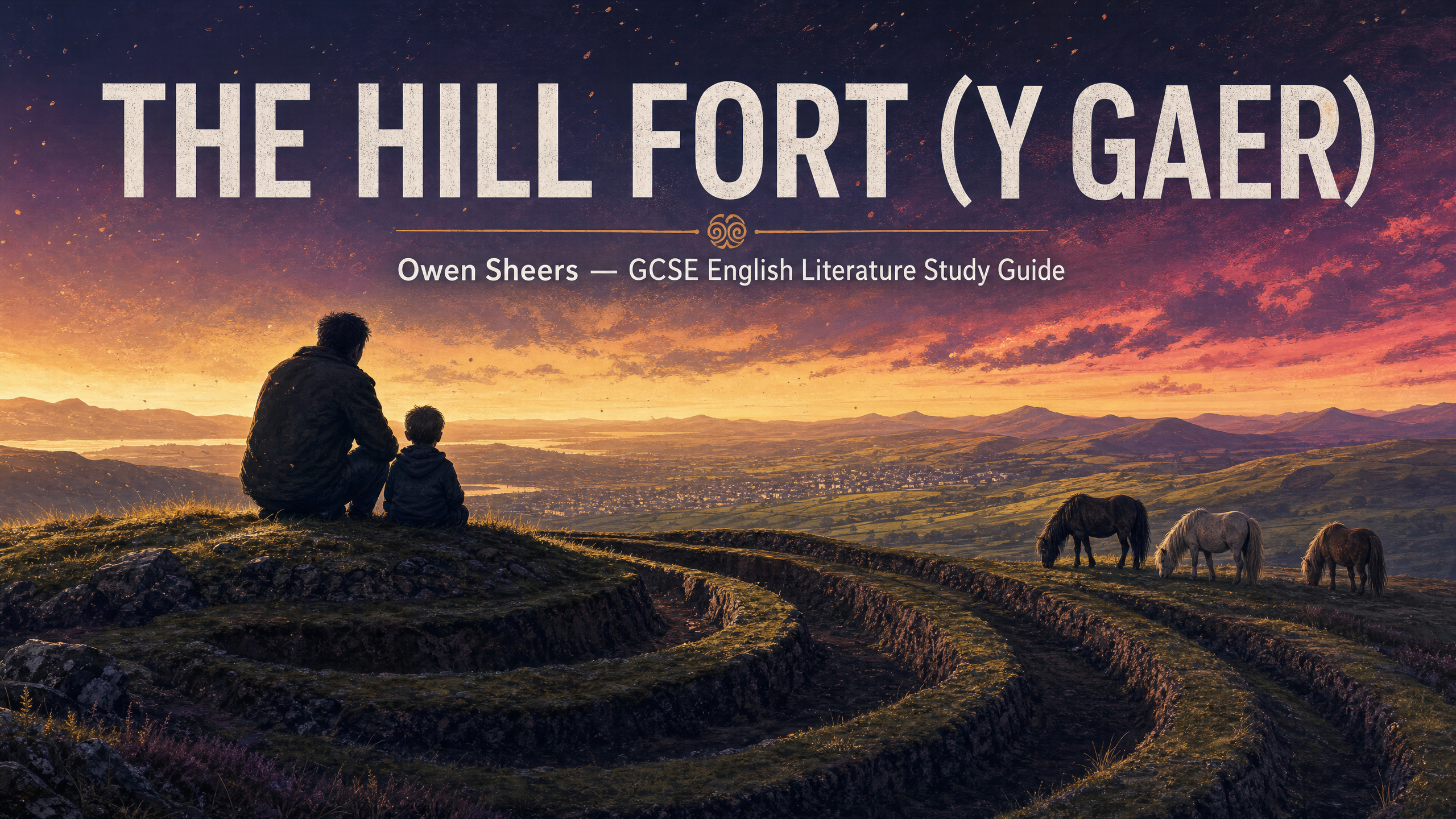
Owen Sheers' 'The Hill Fort' (also known by its Welsh title, 'Y Gaer') is a deeply moving poem from his 2005 collection Skirrid Hill. It explores the relationship between a father and his young son, and the father's subsequent grief following the son's death. The poem is a masterclass in restraint, using the ancient Welsh landscape as both a setting for memory and a mechanism for coping with profound loss. Examiners consistently reward responses that move beyond simply identifying the tragedy, and instead analyse how Sheers uses form (the shift from past to present) and imagery (the integration of man and nature) to convey the enduring nature of love and the comforting permanence of the land.
Podcast Episode
Listen to our comprehensive 10-minute podcast exploring the core themes, exam techniques, and structural analysis of 'The Hill Fort'.
Content Overview
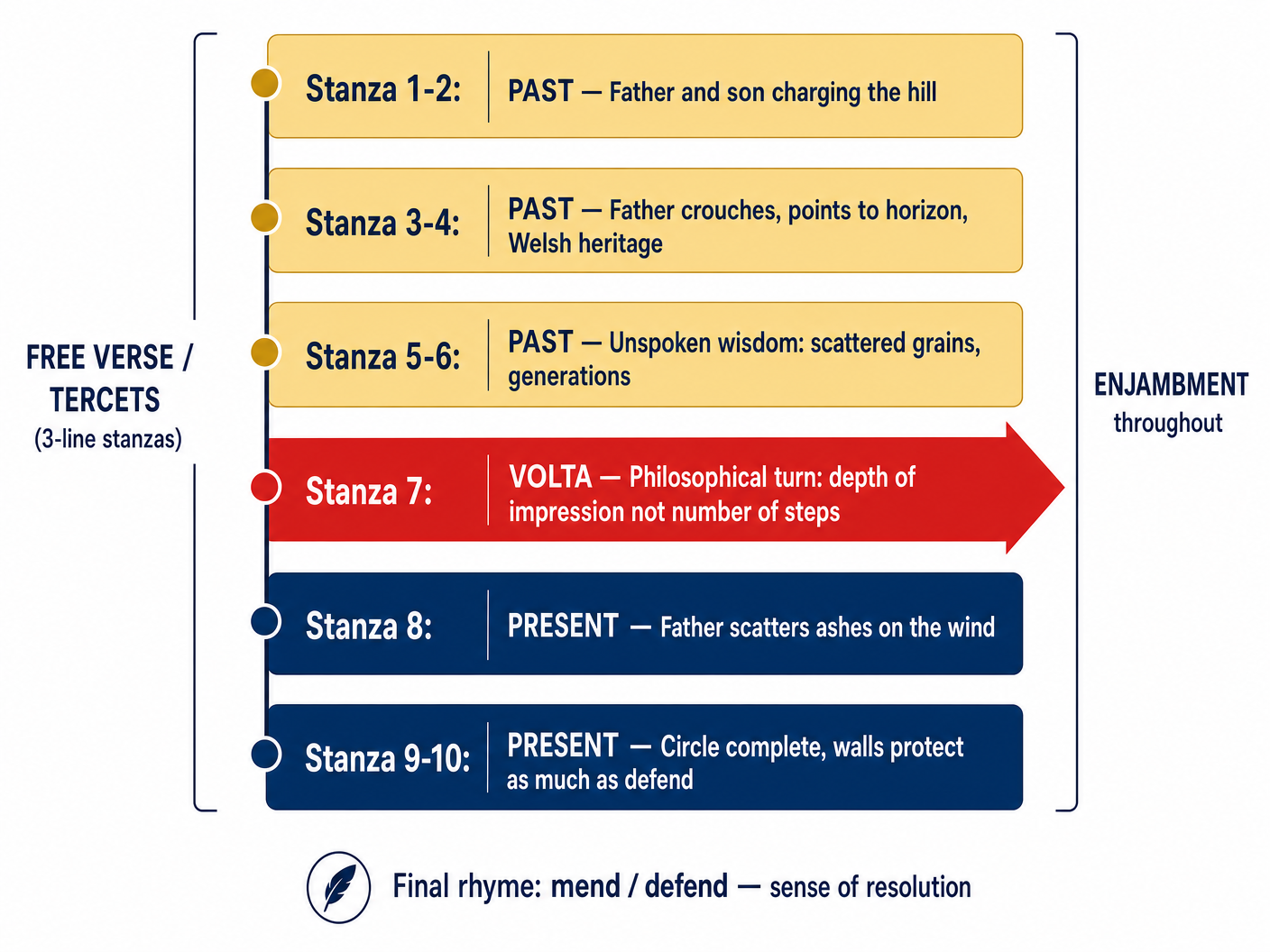
- Stanzas 1-6 (The Past): A father remembers bringing his energetic young son to an ancient hill fort. He crouches to the boy's level, pointing out Welsh towns on the horizon, attempting to impart unspoken wisdom about the long lineage of generations and the fleeting nature of life.
- Stanza 7 (The Volta): The philosophical pivot of the poem. The father's unspoken thought concludes: what matters is not the length of a life ("the number of steps"), but its impact ("the depth of their impression").
- Stanzas 8-10 (The Present): The devastating reveal. The father has returned to the fort alone to scatter his son's ashes. He seeks comfort in the ancient walls that, despite being ruined, still offer protection and a sense of enduring history.
Themes
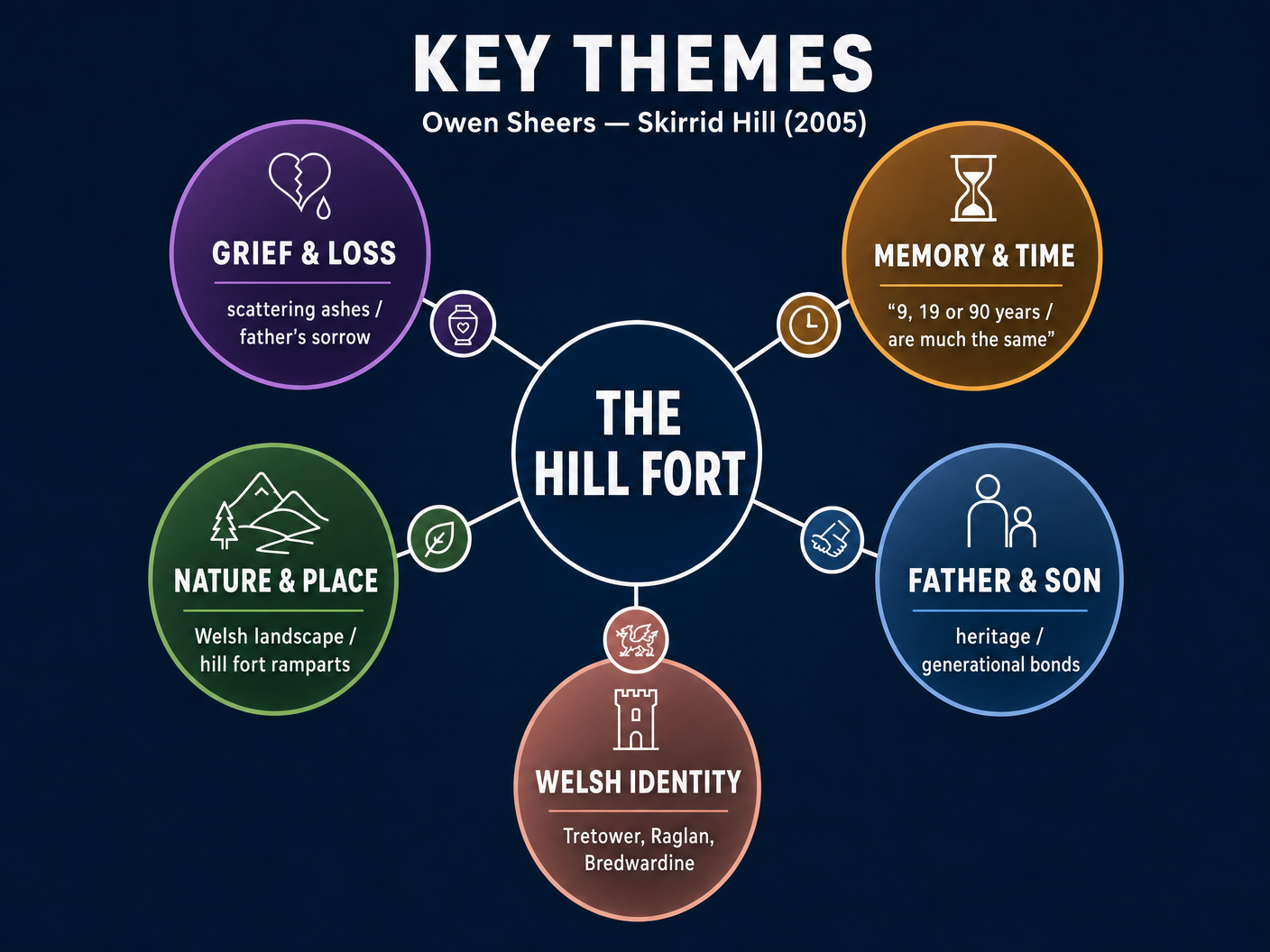
Theme 1: Grief and Loss
The poem handles grief with remarkable restraint. The death of the son is never explicitly stated; it is revealed through the action of scattering ashes in stanza eight. This delayed revelation makes the loss more impactful, contrasting sharply with the vitality of the boy in the opening stanzas.
Key Quotes:
- "to tip these ashes onto the tongue of the wind" (Stanza 8) - The personification of the wind suggests nature actively receiving the boy, offering a comfort that human words cannot.
- "watch them spindrift into the night" (Stanza 8) - The nautical term 'spindrift' (spray blown from waves) conveys the fragility and uncontrollable scattering of the ashes, highlighting the finality of loss.
Theme 2: Memory and Time
Sheers contrasts the fleeting nature of a human lifespan with the deep, geological time of the landscape. The poem suggests that memory preserves the essence of a person, even when their physical presence is gone.
Key Quotes:
- "9, 19 or 90 years / are much the same" (Stanza 6) - The father's unspoken wisdom takes on a tragic retrospective irony. He meant to teach his son about the vastness of history, but the words become a necessary comfort for his own premature loss.
- "it isn't the number of steps / that will matter, / but the depth of their impression" (Stanza 7) - The central philosophical message. A short life can still leave a profound and lasting mark on those left behind.
Theme 3: Father and Son (Heritage)
The bond between father and son is central, intertwined with a sense of Welsh identity and generational continuity. The tragedy lies in the breaking of this generational line.
Key Quotes:
- "he'd crouch so their eyes were level" (Stanza 3) - A gesture of equality, intimacy, and protection. It establishes the deep physical and emotional connection between them.
- "pointing out all the places lived in / by the fathers and sons before them" (Stanza 4) - Roots their relationship in a wider historical and cultural context, emphasizing the tradition of passing knowledge from one generation to the next.
Theme 4: Nature and Landscape
The Welsh landscape is not merely a backdrop; it is an active participant in the poem. It represents vitality (the ponies), history (the fort), and ultimately, a source of solace and protection.
Key Quotes:
- "as wild as the long-maned ponies" (Stanza 1) - Aligns the boy's youthful energy with the untamed natural world.
- "protect as much as they defend" (Stanza 10) - The ancient walls of the fort, though ruined, offer emotional shelter to the grieving father. The landscape provides a permanence that human life lacks.
Writer's Methods
Structure and Form
- Tercets: The poem is written in ten three-line stanzas (tercets). This form is typical of Welsh poetry and provides a steady, measured pace, reflecting the solemnity of the subject matter.
- Free Verse: The lack of a regular rhyme scheme or metre gives the poem a conversational, reflective tone, mimicking the natural flow of the father's thoughts and memories.
- Enjambment: Sheers uses enjambment extensively (e.g., between stanzas 1 and 2: "charging the hill / as wild as the long-maned ponies / who'd watch a moment"). This creates a sense of continuous movement, reflecting the boy's energy in the past, and the continuous flow of time and memory.
- The Volta (Turn): The pivotal shift occurs in stanza 7. The poem moves from the past tense (memory) to the present tense (the scattering of ashes). This structural divide mirrors the permanent separation caused by death.
- Final Rhyme: The poem concludes with its only full rhyme: "mend" / "defend" (Stanzas 9/10). This creates a sense of finality and resolution, suggesting the father has found some measure of peace or acceptance within the landscape.
Language
- Restraint: The language is colloquial and direct, avoiding overly emotive or melodramatic vocabulary. The tragedy is conveyed through simple, devastating facts (the ashes) rather than explicitly stated feelings.
- Personification: Nature is personified (e.g., "the tongue of the wind"), integrating the human experience of grief with the natural world.
Context
- Welsh Identity: Sheers frequently explores Welsh identity and landscape. The bilingual title ('Y Gaer' / 'The Hill Fort') reflects the linguistic and cultural duality of Wales. The specific place names (Tretower, Raglan, Bredwardine) ground the poem in the Welsh borders, a landscape steeped in history and conflict.
- Skirrid Hill: The collection's title comes from 'Ysgirid Fawr', a Welsh mountain whose name derives from 'ysgariad', meaning divorce or separation. This theme of separation (between people, between past and present) permeates the collection.
- The Diptych: 'The Hill Fort' is paired with another poem in the collection called 'Y Gaer'. They form a diptych (a pair of linked works). While 'Y Gaer' focuses on the anger of grief against a stormy landscape, 'The Hill Fort' focuses on quiet remembrance and the comforting aspects of nature on a "clear day".
Visual Resources
2 diagrams and illustrations
Interactive Diagrams
1 interactive diagram to visualise key concepts
Conceptual Flow Outline
The structural and emotional progression of 'The Hill Fort'
Worked Examples
2 detailed examples with solutions and examiner commentary
Practice Questions
Test your understanding — click to reveal model answers
Explore how Sheers presents the relationship between humanity and the natural world in 'The Hill Fort'.
Hint: Consider how nature acts as a mirror for the boy's energy initially, but later becomes a source of comfort and permanence for the grieving father.
How does Sheers use structure and form to convey meaning in 'The Hill Fort'?
Hint: Focus on the use of tercets, the lack of rhyme until the very end, the extensive enjambment, and the crucial volta in stanza 7.